
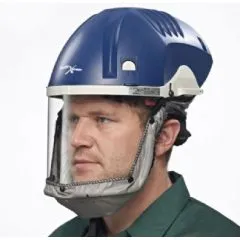
Choosing respiratory protective equipment can become more complicated when an employee has a beard or substantial facial hair. Many common respirators depend on close contact between the facepiece and the wearer’s skin. If hair crosses that sealing area, small gaps can allow contaminated air to bypass the filter.
This is more than a comfort issue. The effectiveness of respiratory protective equipment depends on selecting a suitable product and ensuring that it works properly for the individual who will wear it.
UK Health and Safety Executive guidance states clearly that a respirator which depends on facial fit will not provide adequate protection where a beard or heavy stubble prevents the required seal.
Why Facial Hair Causes Problems with Tight-Fitting Masks
A tight-fitting respirator is designed to create a seal around part or all of the face. During breathing, air should pass through the intended filtration system rather than around the edges of the facepiece.
Hair trapped beneath the sealing surface creates an uneven contact area. Even apparently short stubble may affect that seal.
HSE guidance explains that poor fit is one of the major causes of RPE leakage and that tight-fitting facepieces need to fit the wearer properly to be effective.
This is why simply tightening the straps is not an appropriate solution to facial-hair interference.
A Specialist Option for Bearded Workers
Where workers need respiratory protection but cannot achieve an adequate seal with conventional tight-fitting equipment, employers should consider equipment designed around a different principle.
Searching for a suitable dust mask for beards may lead to loose-fitting powered hood or helmet systems rather than an ordinary disposable mask. These systems can supply filtered air to a headtop without depending on the same close facial seal used by many conventional respirators. Protective Masks Direct specifically identifies powered hood systems as an option for workers with facial hair.
The choice should still be based on the workplace hazard and the required protection level. Facial-hair compatibility alone does not establish that a particular respirator is suitable for the substance involved.
Where FFP3 Respirators Fit In
FFP classifications are commonly encountered when selecting protection against workplace particulate hazards. An FFP3 mask sits within the higher-performance category of filtering facepiece respirators intended for particles. Protective Masks Direct stocks disposable and reusable options for applications requiring higher particulate protection.
However, the FFP3 classification does not remove the need for correct fit.
If an FFP3 respirator is a tight-fitting facepiece, facial hair in the sealing area can still compromise its performance. HSE guidance therefore requires employers to consider fit rather than relying on the filter classification alone.
This distinction is important because purchasing a higher-rated filter cannot compensate for air leaking around the edge of the mask.
Face-Fit Testing Has a Specific Purpose
Face-fit testing determines whether a particular make, model, type and size of tight-fitting respirator can create an adequate seal for an individual wearer.
It should ideally take place during the initial selection of respiratory equipment. HSE guidance also recommends making the same successfully tested make, model, type and size available to the employee for use.
Fit testing should not be confused with the pre-use check completed when the respirator is put on.
Workers should still inspect and correctly position their equipment each time it is worn.
Do Not Select RPE in Isolation
Respiratory protection should form part of a wider system for controlling airborne exposure. Employers should first consider whether risks can be removed or reduced through measures such as extraction, enclosure, process changes or dust suppression.
HSE advises that PPE and RPE should be used within the wider hierarchy of workplace controls rather than automatically becoming the first response to a hazard.
When RPE remains necessary, selection should consider:
- The contaminant and its concentration
- Required protection factor
- Facial hair and face shape
- Duration of wear
- Other PPE used at the same time
- Filter or battery maintenance
- Cleaning and storage requirements
This produces a more reliable approach than simply issuing the same mask to every employee.
Training Matters Too
Even suitable equipment can perform poorly if employees have not been shown how to use it.
Training should cover how to put RPE on, inspect it, recognise damage and store it correctly. Powered systems may also require instruction on battery charging, airflow indicators, filters and headtop maintenance.
Employees should understand why particular equipment has been selected rather than treating respiratory protection as an optional accessory.
Conclusion
Facial hair can have a direct effect on respiratory protection where a mask depends on a tight seal against the skin. A higher filter classification does not solve a poor-fit problem, which is why employers need to consider face-fit testing and alternative equipment where necessary.
Loose-fitting powered hoods can provide a practical option for some bearded workers because they do not rely on the same facial seal as conventional tight-fitting respirators. Whatever system is chosen, it must still match the specific airborne hazard, required protection level and working conditions.
Effective RPE selection comes from combining risk assessment, correct equipment, proper fit, maintenance and worker training rather than relying on the mask label alone.