

Scunthorpe United is a football club that is built on passion, unity and resilience. From high moments of progression to devastating lows that almost left the club in the bottom tiers of the game, Scunthorpe fans have been through it all. Many modern clubs have big investors, from international conglomerates, global brands, or even companies that provide casino slots online, but the story of Scunthorpe United matches their passionate slogan of unity that has kept the club afloat. So let’s take a look at the history of this great English football club.
The Origins
Back in 1899, a small club known as Scunthorpe FC was formed, but it quickly merged with local rivals Lindsey United to form Scunthorpe & Lindsey United in 1910. In 1912, they joined the Midland Football League, where they would win the league twice and finish runners up once before the end of the Second World War, while continuously applying and being denied a place in the English Football League. After the war, they finished as runners-up again and were eventually given a spot in the EFL in 1950. This was just the start of Scunthorpe United.
The Initial Challenges
In 1958, Scunthorpe were awarded their first promotion from the Third Division into the Second Division. They maintained their presence in the second division for 5 years, constantly climbing the table, however, it was in 1964 when Scunthorpe finished bottom of the Second Division and were sent back down into the Third Division. From that point onward, Scunthorpe experienced plenty of promotions and relegations, bouncing around Division 3 and Division 4, and settling in the 4th Division by 1987. During the time between 1964 and 1987, a young talent known as Kevin Keegan came through the ranks and was sold to Liverpool for £35,00 in 1971, who would go on to win 2 Ballon d’Ors. At this point, it was clear that something at Scunthorpe United had to change.
A New Direction
In 1988, Scunthorpe United chose to leave their home ground, the Old Show Ground, to become the first club in England to move to a purpose-built stadium. The new stadium, Glanford Park, was a sign and a signal to the supporters that preparations and planning to get Scunthorpe to the top of English football were commencing, but there was one final season left at the Old Show Ground in 1988 that almost wrote history. In that season, Torquay United took the Iron out of the Division 4 play-offs, ruining any dreams of a fairytale ending in their final game at their home ground. After a few playoff upsets and a first visit to Wembley in 1992, United remained in Division 4 and didn’t seem to have any momentum to push them past the play-offs. Plenty of managers tried and failed, but it wasn’t until 1997 that a new era unfolded, with more potential to get promoted than ever.
The 2000s Push
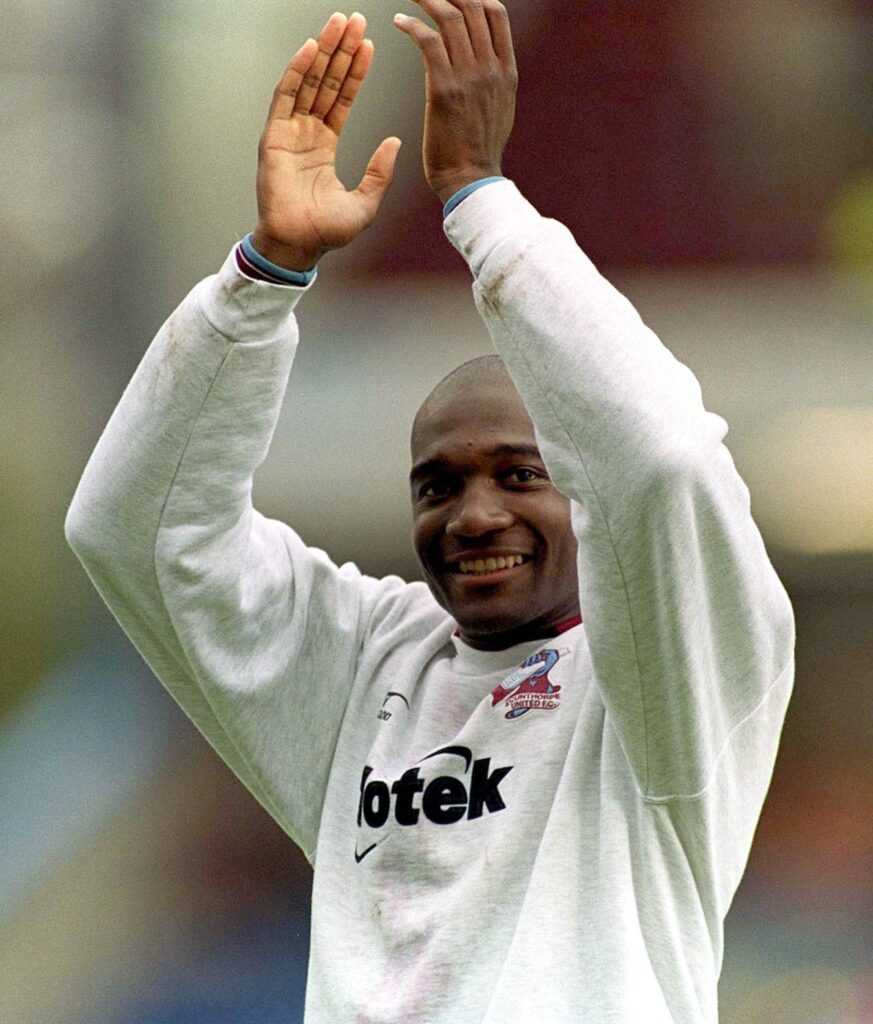
In 1997, new manager Brian Laws was appointed, and in his first season, he took the Iron one point away from the now Division 3 play-offs, providing some hope and sense of belief for the Scunthorpe supporters. The following season was exactly what United fans had been waiting for: a fourth-place finish that secured the Division 3 play-offs. Unlike any of their recent play-off attempts, Scunthorpe went on to beat Swansea City 3-2 on aggregate, and finally defeated Leyton Orient 1-0 at Wembley to be promoted to Division 2. Unfortunately for the Iron, the first season in Division 2 didn’t end well, landing them in 23rd place and relegating them back to the 3rd Division.
After a playoff upset and a league rebrand, Scunthorpe were promoted back into the EFL League One just a few years later, even cementing their place in the league with a mid-table finish in the 2005/06 season. At this point, new boss Nigel Adkins took the wheel and managed to win League One, promoting Scunthorpe into England’s second-highest division, the Championship. This season was record-breaking for the Iron, accumulating 91 points and going on the club’s longest unbeaten run of 16 games. But in typical and familiar fashion, Scunthorpe were relegated the following season, back into the EFL League One.
In the 2008/09 season, United were promoted back to the Championship through the play-off games, but this time retained their position in the following season. However, upon Adkins’ departure in the 2010/11 season, Scunthorpe finished rock bottom, relegating them back to League One. This was the beginning of the end.
The Beginning of the End
For many years after their relegation in 2011, Scunthorpe battled with the owner and management changes, seeing them drop in the leagues over time. Despite breaking the record for the longest unbeaten run in EFL history, 28 games, by 2021, United struggled during the COVID pandemic and in 2022, was relegated to the National League for the first time in 72 years. The 2022/23 season was another year to forget, with back-to-back relegation after a change of owner, and a risk of administration, leaving them in the National League North. The 2023/24 season was promising, with yet another new owner taking charge, landing them in the National League North playoffs, narrowly being defeated. But it was a great sign for the future.
So What Now?
Scunthorpe has a bright future ahead. They are battling in the National League North to get back where they belong in the EFL. Their story of strong resilience and incredible fanbase is just a few reasons why, with the right direction and belief, Scunthorpe United can make it back to the English Football League.